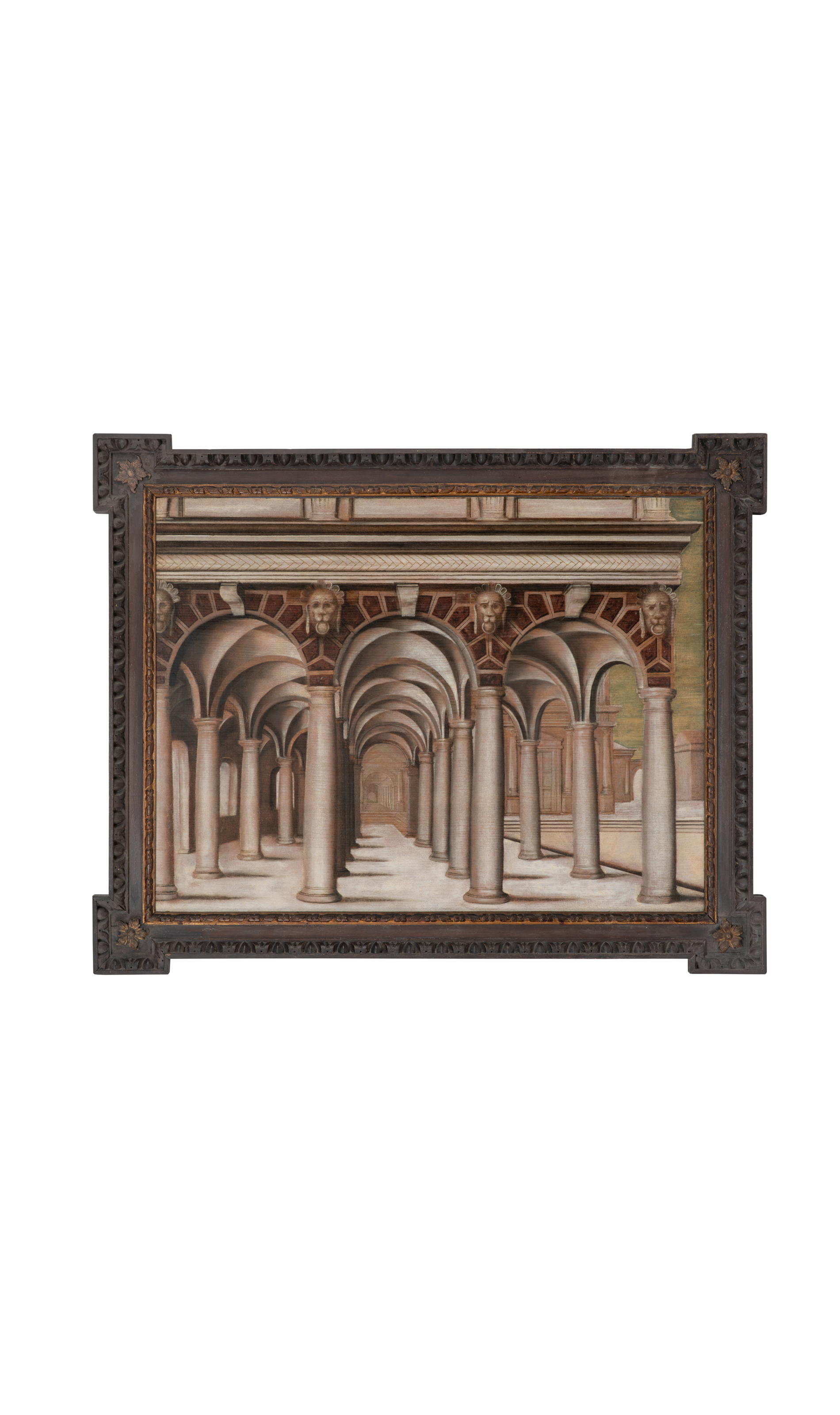
Oil on Oak Panel, English School c.1600, After the Original Design by Hans Vredeman de Vries (1527–c. 1607), c.1560.






Oil on Oak Panel, English School c.1600, After the Original Design by Hans Vredeman de Vries (1527–c. 1607), c.1560.
Oil on Oak Panel, English School c.1600, After the Original Design by Hans Vredeman de Vries (1527–c. 1607), c.1560, in an English Neo-Palladian Frame in the Manner of William Kent retaining its Original Painted Finish.
Provenance
Christopher Gibbs, pictured in situ in El Foolk, his house in Tangier (fig.1).
By Descent to Peter Hinwood esq.
Detail Description
This fine oil on oak panel is inspired by an architectural study by Hans (or Johannes) Vrederman de Vries (fig.2), member of the famous family of architects and artists who were crucial to the development of the architectural style in the Netherlands during the 16th century. Hans was known locally as 'the king of the architects' and it was during his first residency in Antwerp, between c.1555 and 1560 that many of his most famous architectural commissions were executed. The present composition is based on an engraving, published by de Vries' regular collaborator Hieronymous Cock of Antwerp and engraved by the Doetechum brothers Lucas and Johannes. As the print, illustrated below, was published in 1560 this allows the original design for the piece to be dated very accurately. A fine impression of the print is included with the present painting, but other impressions survive in many notable museum collections such as the National Gallery of Art in Washington DC.
The design features as its primary subject an open hall, bordering onto a town square. The hall is supported by a series of Tuscan columns culminating in rusticated quoins centred by grotesque lion masks and a finely vaulted ceiling. Vredeman de Vries was famous for his mastery of perspective and this skill is entirely evident in both the print and the present painting.
Vredeman de Vries was appointed court architect in Antwerp but his career there was ended by religious turmoil. A Protestant, he moved around European court centres during this period of religious turmoil, being forced to move on when Catholic powers took control of the countries or areas in which he worked, such as the Spanish invasion of Antwerp in 1585. The far-reaching impact of Vredeman de Vries' work is demonstrated by the fact that the Great Bed of Ware, one of the most famous of all pieces of English furniture, executed c.1590 and now in the Victoria and Albert Museum, features decoration copied from prints made after his designs. Given the fame acquired by de Vries' designs throughout Europe at this time, particularly in England, where the work of a Protestant designer was especially sympathetically received, it is likely that the artist of the present piece painted it c.1600 for an English client. The painting remained in England since, later acquiring its spectacular Kentian frame c.1745.
Although the artist who created the present work has not been identified, they have remained faithful to the spirit of the original printed design. The present piece is entirely typical of de Vries' masterful melding of architectural perspective and academic subjects with decorative features.
This piece is contained in a mid 18th century English frame in the neo-Palladian style promoted by the likes of William Kent and Henry Flitcroft. The frame retains its original painted finish and enhances the painting significantly. It was no doubt this fusion of the work of two architectural masters, both skilled painters, that attracted the late dealer Christopher Gibbs to the piece. It was part of his private collection in his house in Tangier, El Foolk, and came by descent to Peter Hinwood esq., from whom we acquired the piece privately.
Print Format


